Key Parameters of TCXO
2026-05-30
TCXO, fully named Temperature Compensated Crystal Oscillator, is a type of quartz crystal oscillator. It adopts a built-in temperature compensation circuit to reduce the influence of ambient temperature changes on oscillation frequency. Quartz crystal oscillators are mainly classified into Crystal Oscillator (XO), Voltage Controlled Crystal Oscillator (VCXO), Temperature Compensated Crystal Oscillator (TCXO) and Oven Controlled Crystal Oscillator (OCXO), etc.
Its core working principle is to detect ambient temperature with temperature sensors, and adjust oscillation parameters via compensation algorithms or circuits to offset temperature-induced frequency drift. Compared with ordinary XOs, TCXOs feature higher frequency stability and accuracy. Compared with OCXOs, TCXOs have the advantages of lower cost, lower power consumption and smaller size.

1. Frequency
The ideal output frequency of a crystal oscillator is usually expressed in megahertz (MHz), ranging from several kilohertz (kHz) to hundreds of megahertz.
TCXOs generally have a frequency range of 20 MHz to 36 MHz, where crystal oscillators achieve the best stability and reliability. This frequency range is also applicable to most scenarios such as wireless communications and audio equipment.
2. Frequency Accuracy
Frequency accuracy refers to the deviation between the actual output frequency and the nominal frequency of a TCXO at the reference temperature of 25°C, with the unit of ppm (parts per million). It indicates the offset between the operating frequency and the reference frequency. Higher accuracy means better stability of the crystal oscillator. The typical accuracy ranges from 1 ppm to 5 ppm, while high-precision TCXOs are priced higher accordingly.
3. Operating Temperature
The standard operating temperature range of TCXOs is -40°C to +85°C.
Temperature StabilityIt is the core technical advantage of TCXOs. When the ambient temperature varies drastically within -40°C to +85°C, the frequency drift of ordinary crystal oscillators can reach ±20 ppm to ±100 ppm. In contrast, TCXOs apply real-time regulation through the temperature compensation network, limiting the frequency drift to ±0.1 ppm ~ ±5 ppm.
Long-term StabilityA crystal oscillator’s frequency drifts slowly over time due to quartz crystal aging and component characteristic variation, which is generally measured in ppm/year. Premium TCXOs control the annual drift within ±0.1 ppm to ±1 ppm, equivalent to a total cumulative deviation of no more than 10 ppm after 10 years of operation.
Short-term StabilityIt characterizes frequency fluctuations on a millisecond to second timescale, quantified by phase noise or Allan variance. In high-speed data transmission systems, excessive short-term fluctuations will cause signal eye diagram closure. By optimizing the oscillation circuit design, TCXOs can keep the phase noise below -110 dBc/Hz at a 1 kHz frequency offset.
4. Package Dimensions
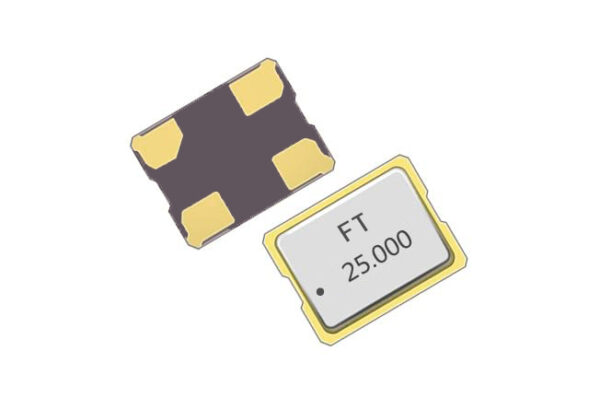
Package types shall be selected according to PCB space and layout requirements. Different packages correspond to different mounting methods and electrical characteristics. TCXOs are usually smaller than ordinary crystal oscillators, suitable for compact product designs. Common sizes include 1.56 mm, 2.56 mm and 3.27 mm.
5. Operating Voltage
Most mainstream TCXOs are powered by DC voltages of 1.8 V, 2.5 V or 3.3 V, which need to match the system power rail.
6. Response Time
The response time of a TCXO refers to the time taken for the output signal to change after the input signal is altered. A shorter response time enables the oscillator to respond faster to environmental changes and maintain better stability.
Crystal Oscillators Support Perfect Rendering on AI Glasses
Meet in Moscow | 2026 Expo Electronica Russia